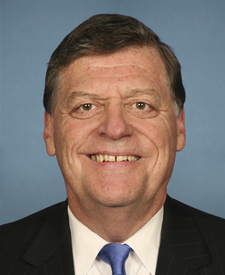
RepublicanTom Cole
U.S. Representative · Oklahoma
Oklahoma's 4th district
U.S. Representative from Oklahoma
4 tracked promises
Trust rating
Not yet rated
Not enough rated promises yet to provide an accurate Trust Rating.
Their tracked promises haven’t been rated against the record yet.
A Trust Rating appears once their promises have been rated against what they actually did. How this is measured. Help build the record →
How they won their seat
Tom Cole won the 2024 U.S. House election in Oklahoma (District 4) with 65.2% of the vote (199,962 votes).
- Tom Cole · Republican65.2%199,962
- Mary Brannon · Democrat28.3%86,641
- James Stacy · Independent6.5%19,870
Certified results. Source: MIT Election Data + Science Lab (MEDSL) ↗. A plurality winner can hold under 50% when more than two candidates run.
Inferred legislative agendas
Tom Cole's record shows a focus on appropriations and funding measures, as evidenced by his sponsorship of multiple appropriations acts, including the Department of Homeland Security Appropriations Act (HR 7744) and the Consolidated Appropriations Act (HR 7148). Additionally, he has sponsored legislation aimed at addressing issues related to tribal relations, such as the Truth and Healing Commission on Indian Boarding School Policies Act (HR 7325) and the Tribal Warrant Fairness Act (HR 7490). Focus areas (from the record): Appropriations · Tribal Relations · Healthcare · Social Security · Legislative Oversight Alignment with declared positions: Mixed. Cole's sponsored bills are consistent with his declared positions on Social Security and tribal relations, as seen in his support for the Bipartisan Social Security Commission Act (HR 9187) and the Truth and Healing Commission on Indian Boarding School Policies Act (HR 7325). However, the record shows a focus on appropriations without indicating the reflection of healthcare promises, such as the Medical Student Education Authorization Act (HR 5428). What this can't tell you: The record does not reveal the effectiveness of the sponsored bills or their impact; There is no information on the politician's unlogged work or informal efforts; The record does not provide insight into the politician's motives or personal beliefs. Confidence: moderate (based on the volume of verified record on file).
Inferred, not stated. Tom Cole has not necessarily stated these as goals. This is an AI-generated, nonpartisan reading of the patterns in their verified record — sponsored legislation, committee work, roll-call votes, and campaign-finance composition — and how those patterns compare to any declared positions and tracked promises. It describes what the record emphasizes, never imputes motive, and is run through an adversarial review pass that scrubs bias, loaded language, and any claim the evidence doesn’t support. It is not a quote, a claim they made, or a rating; every underlying item is sourced in the verified record below; and it never affects the Integrity Score.
Showing 2026. Every tile and chart below reflects this window; some record types (e.g. roll-call votes) only have data for recent years.
Activity in office
What Tom Cole has actually done in office — sourced from official roll-call and government records, shown in full below. These are facts, separate from tracked promises and never folded into any score. The tracked-positions tile counts sourced stated positions — claims about what they believe, not conduct — and is likewise never scored.
Roll-call data last updated September 7, 2026 · source: Voteview.
Monthly voting activity
- Yea
- Nay
- Total
Roll-call votes per month — most recent on file. Source: Voteview.
Vote attendance
Share of roll calls participated in — most recent votes on file. Source: Voteview.
Bills sponsored over time
Bills sponsored per year, stacked by outcome (latest action). Outcome data covers the 118th–119th Congresses; earlier years show as “awaiting status” until enriched. Source: Congress.gov.
Independence
How often they break with their party’s majority — neither good nor bad, just the record.
Most recent roll-call votes on file. Source: Voteview.
Bill success rate
Bills SPONSORED in the 118th–119th Congresses, by their latest action. Source: Congress.gov.
Campaign finance over time
- Small-dollar (unitemized)$35K2%
- Large individual (itemized)$792K44%
- PAC / committee$968K54%
By election cycle. Source: FEC.
Committee memberships
- Chair, House Committee on AppropriationsOn record since Jan 2025Chair
Source: Congress.gov.
Integrity
Not yet ratedNo promises have been rated yet, so there is no Integrity Score to show. Lifecycle promises (in progress, not yet rated) are tracked but never scored.
The score, once promises are rated, is a signed −100…+100 breakdown weighted by significance and evidence confidence — never a single opaque grade. How this is measured.
Integrity over time
Topic coverage
4 promises across 3 topicsWhat this record covers — the number of tracked promises per topic. This is coverage, not a verdict; the kept/against shading within each bar mirrors the Integrity breakdown above.
- tribal relations2
- healthcare1
- Social Security1
Evidence & significance
Evidence quality
Strongest source cited per promise.
- Primary (official record)4100%
Significance mix
How weighty the tracked promises are (1 = minor, 5 = defining).
Significance weights each promise in the Integrity Score.
4 tracked promises
“I will pass the Bipartisan Social Security Commission Act (H.R. 9187) to create a 13-member bipartisan commission required to produce, within one year, a plan to ensure Social Security's long-term solvency.”
“I will pass the Truth and Healing Commission on Indian Boarding School Policies Act (H.R. 7325) to create a federal commission to formally investigate, document, and report on the history, policies, and long-term effects of U.S. Indian boarding schools.”
“I will pass the Tribal Warrant Fairness Act (H.R. 7490) to grant the U.S. Marshals Service authority to execute arrest warrants on behalf of Tribal law enforcement and to assist in searching for missing Native children.”
“I will pass the Medical Student Education Authorization Act (H.R. 5428) to authorize the Medical Student Education Program through Fiscal Year 2028, funding grants that expand physician training in states with the most severe primary-care shortages.”
Verified record
207 sponsored billsFacts imported directly from official government sources — shown separately from tracked promises and never folded into the Integrity Score. Each entry links to its primary source.
Sponsored legislation
- Sponsored HR 9187: Bipartisan Social Security Commission Act of 2026 ↗Jun 8, 2026
- Sponsored HR 7744: Department of Homeland Security Appropriations Act, 2026 ↗Mar 2, 2026
- Sponsored HR 7490: Tribal Warrant Fairness Act ↗Feb 11, 2026
- Sponsored HR 7325: Truth and Healing Commission on Indian Boarding School Policies Act of 2026 ↗Feb 3, 2026
- Sponsored HR 7148: Consolidated Appropriations Act, 2026 ↗Jan 20, 2026
- Sponsored HR 7147: Homeland Security and Further Additional Continuing Appropriations Act, 2026. ↗Jan 20, 2026
- Sponsored HR 7006: Financial Services and General Government and National Security, Department of State, and Related Programs Appropriations Act, 2026 ↗Jan 12, 2026
- Sponsored HR 6938: Commerce, Justice, Science; Energy and Water Development; and Interior and Environment Appropriations Act, 2026 ↗Jan 6, 2026
- Sponsored HRES 747: Directing the Clerk of the House of Representatives to request the Senate to return to the House the bill (H.R. 3426) entitled "To amend title 40, United States Code, to limit the construction of new courthouses under certain circumstances, and for other purposes.". ↗Sep 19, 2025
- Sponsored HR 5428: Medical Student Education Authorization Act of 2025 ↗Sep 17, 2025
- Sponsored HR 5371: Continuing Appropriations, Agriculture, Legislative Branch, Military Construction and Veterans Affairs, and Extensions Act, 2026 ↗Sep 16, 2025
- Sponsored HR 5257: To reaffirm the trust status of land taken into trust by the United States pursuant to the Act of June 18, 1934, for the benefit of an Indian Tribe that was federally recognized on the date that the land was taken into trust. ↗Sep 10, 2025
Showing the 12 most recent of 207 sponsored measures.
Voting record
- Total votes
- 655
- Yea
- 492
- Nay
- 155
- Present
- 0
- Not voting
- 8
Full voting record
655 votes- HR4795Yea
- HR1501Yea
- HJRES1Yea
- HRES1498Yea
- HR9436Yea
- HR9436Nay
- HRES1490Yea
- HRES1499Yea
- HRES1499Yea
- HR6500Yea
- S32Yea
- S307Yea
- HR8884Yea
- HCONRES89Nay
- HCONRES113Yea
- HR7008Yea
- HR7008Nay
- HR8800Yea
- HR8800Nay
- HR8800Yea
Roll-call votes, 119th Congress. Source: Voteview (voteview.com). Click any vote to verify it independently.
Positions on record
4 positions on recordThe record on this issue — recorded votes this official cast, and sourced claims about what they believe. Each is labelled with which it is, because a vote is what someone did and a statement is what they said. Neither is scored, and neither affects the Integrity Score.
- Social SecurityStated position
I will pass the Bipartisan Social Security Commission Act (H.R. 9187) to create a 13-member bipartisan commission required to produce, within one year, a plan to ensure Social Security's long-term solvency.
SourcesCongress.gov (U.S. Library of Congress)Committee for a Responsible Federal BudgetU.S. Rep. Tom Cole (cole.house.gov)· archivedView position & sources → - tribal relationsStated position
I will pass the Truth and Healing Commission on Indian Boarding School Policies Act (H.R. 7325) to create a federal commission to formally investigate, document, and report on the history, policies, and long-term effects of U.S. Indian boarding schools.
SourcesGovTrack.usU.S. Rep. Tom Cole (cole.house.gov)· archivedCongress.gov (U.S. Library of Congress)· archivedView position & sources → - healthcareStated position
I will pass the Medical Student Education Authorization Act (H.R. 5428) to authorize the Medical Student Education Program through Fiscal Year 2028, funding grants that expand physician training in states with the most severe primary-care shortages.
SourcesU.S. Rep. Tom Cole (cole.house.gov)· archivedU.S. Rep. Dina Titus (titus.house.gov)· archivedRipon AdvanceView position & sources → - Mass Surveillance, Tracking, and Flock SafetyRecorded vote
On record voting NO on Biggs of Arizona Amendment No. 1 to H.R. 7888, the Reforming Intelligence and Securing America Act, an amendment to prohibit warrantless searches of United States persons' communications in the FISA Section 702 database, with exceptions for imminent threats to life or bodily harm, consent searches, and known cybersecurity threat signatures. The amendment failed on a 212 to 212 tie.
SourcesHouse Roll Call Vote 114, 118th Congress, 2nd Session: On Agreeing to the Amendment, Biggs of Arizona Amendment No. 1 to H.R. 7888, the Reforming Intelligence and Securing America Act. Failed by recorded vote, 212 ayes to 212 noes, April 12, 2024.View position & sources →
Disclosure
A separate measure from the promise scorecard above. It tracks confirmed cases where this official has acted on or championed an issue that already existed when they ran, but which they did not disclose as a priority in their campaign. Each case meets a high evidence bar — three independent sources — and the score is shown alongside the Integrity Score, never merged into it. How this is measured.
No undisclosed priorities on record. This is not a clean-audit claim — it means none have been confirmed for this official.
Suggest a correction to this official's info
See something wrong or out of date — the biography, party, jurisdiction, common name, or photo? Suggest a sourced correction. Every suggestion is reviewed before it changes the record.
Free — it takes a minute. New here? Create an account and complete the Contributor Agreement once.
Office context & community edit history
Help complete the record on this official
What you see above is only what volunteers have catalogued so far — never the whole picture. Know a campaign promise that's missing, or have a source showing one was kept or broken? Add it, and StumpWatch tracks Tom Cole more completely. Every submission must cite where it came from, stays neutral, and is open to correction.